
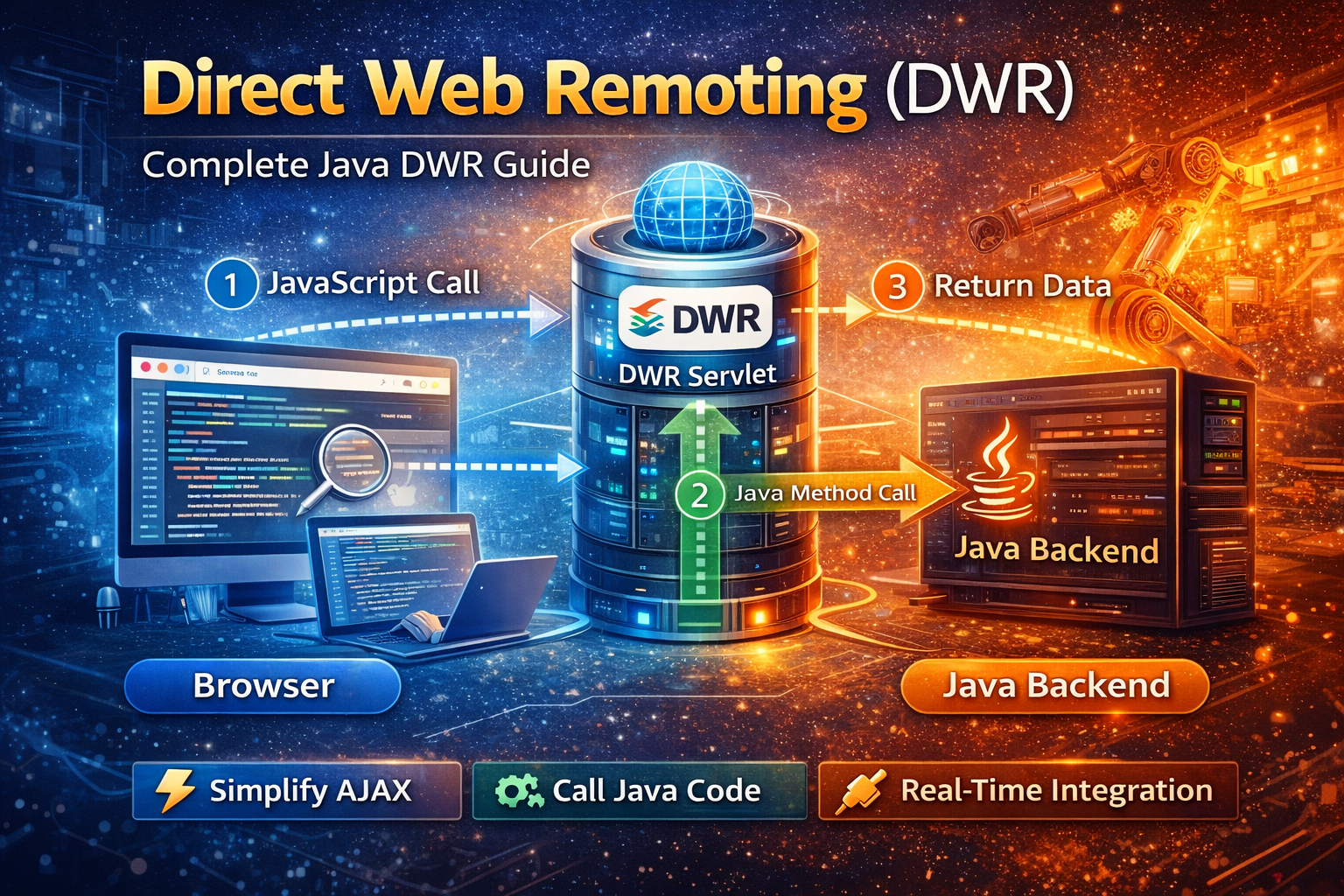

Direct Web Remoting (DWR) is a powerful Java library that allows web developers to call server-side Java code directly from JavaScript running in the browser.
Before modern REST APIs became dominant, DWR was widely used to simplify AJAX-based communication between the client and server.
Even today, many enterprise and legacy Java applications still rely on Direct Web Remoting for seamless front-end and back-end integration.
In this guide, you will learn what DWR is, how it works, how to implement it, and whether it is still relevant in modern web development.
🧠 What is Direct Web Remoting
Direct Web Remoting is a Java library that enables JavaScript running in a browser to interact directly with Java methods on the server.
Instead of manually writing AJAX requests, DWR automatically generates JavaScript proxies for Java classes.
This means you can call Java methods as if they were native JavaScript functions.
🚀 How Direct Web Remoting Works
DWR works by creating a bridge between JavaScript and Java.
Here is the process:
- A Java class is exposed via DWR configuration
- DWR generates a JavaScript proxy
- The browser calls the JavaScript function
- The request is sent to the server
- The Java method executes
- The result is returned to JavaScript
This eliminates the need for manual AJAX coding.
📦 DWR Architecture Overview
DWR consists of several key components:
- Java classes (business logic)
- DWR servlet
- Configuration file (dwr.xml)
- JavaScript proxy files
These components work together to enable real-time communication.
⚙️ Setting Up Direct Web Remoting
To use DWR in a Java application, follow these steps:
🔹 Step 1 Install DWR Library
Add DWR dependency to your project:
<dependency>
  <groupId>org.directwebremoting</groupId>
  <artifactId>dwr</artifactId>
  <version>3.0.2-RELEASE</version>
</dependency>
🔹 Step 2 Configure web.xml
<servlet>
  <servlet-name>dwr-invoker</servlet-name>
  <servlet-class>org.directwebremoting.servlet.DwrServlet</servlet-class>
</servlet><servlet-mapping>
  <servlet-name>dwr-invoker</servlet-name>
  <url-pattern>/dwr/*</url-pattern>
</servlet-mapping>
🔹 Step 3 Create dwr.xml
<dwr>
  <allow>
    <create creator="new" javascript="UserService">
      <param name="class" value="com.example.UserService"/>
    </create>
  </allow>
</dwr>
🔹 Step 4 Create Java Class
public class UserService {
    public String getUserName(int id) {
        return "User " + id;
    }
}
🔹 Step 5 Call from JavaScript
UserService.getUserName(1, function(result) {
    console.log(result);
});
👉 That’s it — Java method directly called from JavaScript.
🎯 Advantages of Direct Web Remoting
DWR offers several benefits:
- Simplifies AJAX communication
- Reduces boilerplate code
- Faster development process
- Easy integration with Java applications
- Real-time updates
For legacy systems, it remains a powerful tool.
⚠️ Disadvantages of DWR
Despite its advantages, DWR has limitations:
- Not widely used in modern applications
- Security risks if not configured properly
- Less flexible than REST APIs
- Harder to scale
Modern frameworks provide better alternatives.
🔐 Security Considerations
Security is critical when using DWR.
Best practices:
- Restrict exposed methods
- Validate all inputs
- Use authentication
- Avoid exposing sensitive data
- Enable HTTPS
Improper configuration can expose your backend.
⚙️ DWR with Spring Framework
DWR can be integrated with Spring.
Benefits include:
- Dependency injection
- Better architecture
- Improved scalability
Example configuration:
<create creator="spring" javascript="UserService">
  <param name="beanName" value="userService"/>
</create>
🔄 DWR vs REST API
This is one of the most common comparisons.
DWR
- Direct Java method calls
- Simpler setup
- Tight coupling
REST API
- Standard HTTP communication
- More flexible
- Better for modern apps
👉 Verdict: REST is preferred today, but DWR is still useful for legacy systems.
🔥 Alternatives to Direct Web Remoting
If you are building a modern application, consider:
- REST APIs (Spring Boot)
- GraphQL
- WebSockets
- AJAX with Fetch API
These provide more flexibility and scalability.
🧠 When Should You Use DWR
Use DWR if:
- You are maintaining a legacy Java system
- You need quick Java-JS integration
- You want minimal setup
Avoid it if you are building new applications from scratch.
🔮 Future of DWR
DWR is no longer a mainstream technology, but it still exists in enterprise environments.
Its relevance is decreasing as modern APIs dominate.
However, understanding DWR is useful for maintaining legacy systems.
🏁 Final Thoughts
Direct Web Remoting was a revolutionary tool in its time.
It simplified JavaScript and Java communication and reduced development complexity.
Today, while newer technologies have taken over, DWR still holds value in legacy systems and specific use cases.
If you are working with older Java applications, learning DWR can be a valuable skill.
❓ FAQ
❓ What is Direct Web Remoting
It is a Java library that allows JavaScript to call Java methods directly.
❓ Is DWR still used
Yes, mainly in legacy systems.
❓ Is DWR better than REST
No, REST APIs are more modern and flexible.
❓ Can DWR be used with Spring
Yes, it integrates well with Spring Framework.