

Commercial Property Management Software
Why Commercial Property Management Software matters for owners and operators
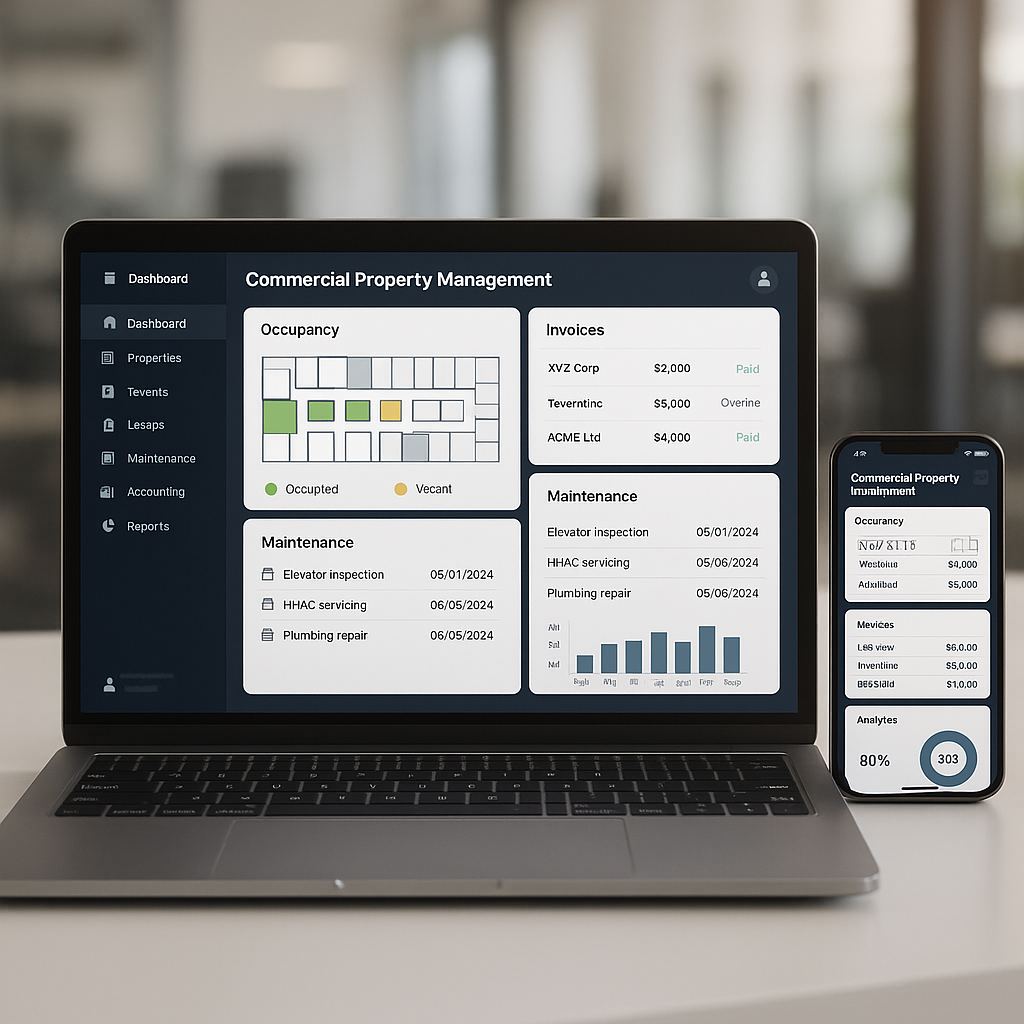
Organizations that manage commercial portfolios require a dependable platform to coordinate leasing, accounting, maintenance and tenant services. Commercial Property Management Software delivers a centralized system of record for asset performance, compliance and tenant engagement.
For procurement teams and operational leaders ready to buy, choosing the right product reduces manual work. It improves revenue capture and supports scalable portfolio growth. It also standardizes processes and surfaces actionable data. purchase intent, selecting the right product reduces manual effort, improves revenue capture and supports scalable portfolio growth by standardizing processes and surfacing actionable data.
Beyond feature lists, focus on measurable results. Aim for a faster month-end close. Improve rent collection efficiency.
Shorten maintenance cycle times. Boost tenant retention. A carefully chosen solution becomes the backbone of operations.
It enables standard reports across funds. It automates recurring reconciliations. It also provides auditable trails for auditors and investors.
Core capabilities to prioritize
When evaluating vendors, prioritize modules that align with your operating model and reporting needs. The most impactful areas include:
- Lease administration and CAM reconciliation—automated rent schedules, step rents, and percentage rent.
- Includes CAM recovery, critical date alerts, and lease abstraction tools.
- These tools reduce manual interpretation risk.
- Accounting and financial reporting. Includes a multi-entity general ledger. Automates AR and AP tasks.
- Supports bank reconciliation. Handles revenue recognition. Provides property-level P&L and balance sheet reports. Includes drill-down capability.
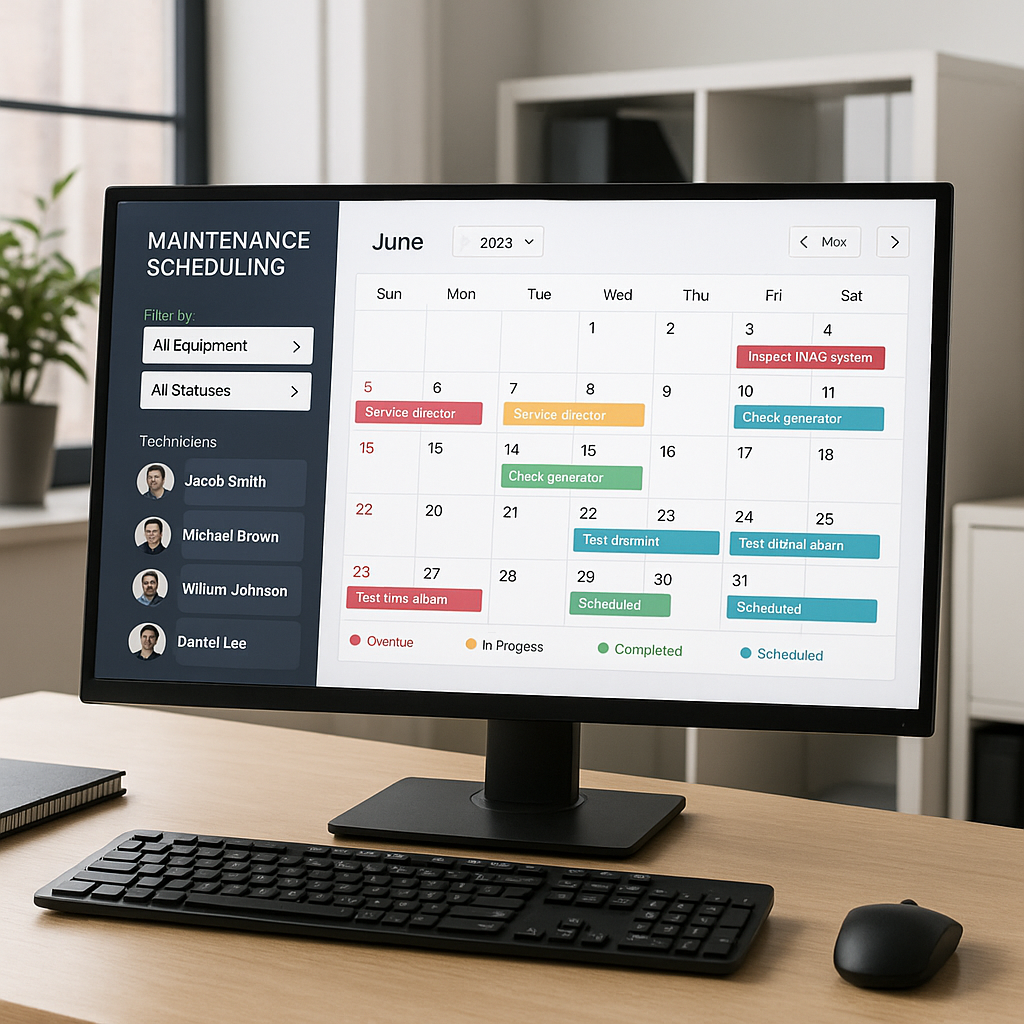
- Work order and maintenance management — tenant service requests, vendor dispatch, SLA tracking, preventative maintenance programs and mobile workflows for technicians.
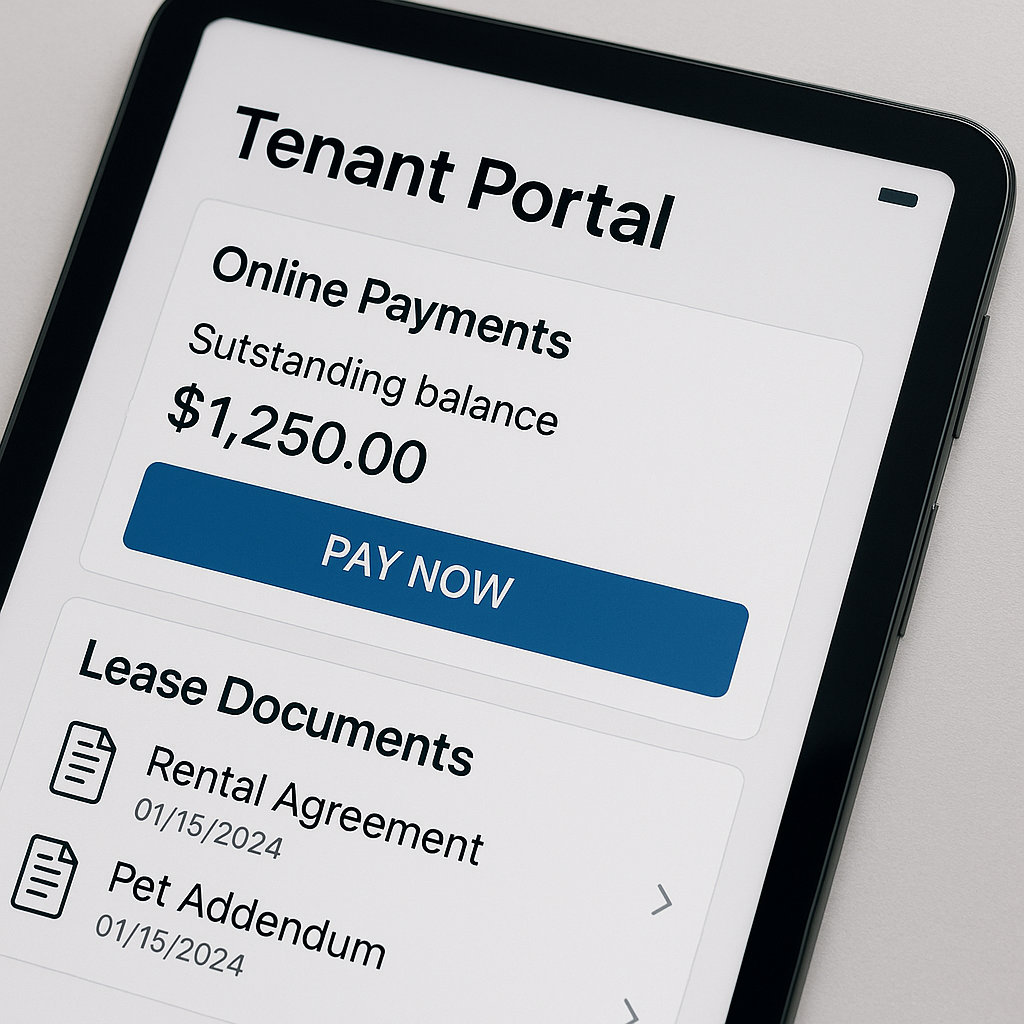
- Tenant portal and communications — online invoicing and payments, e-signature, document exchange, automated notifications and branded portals that improve service transparency.
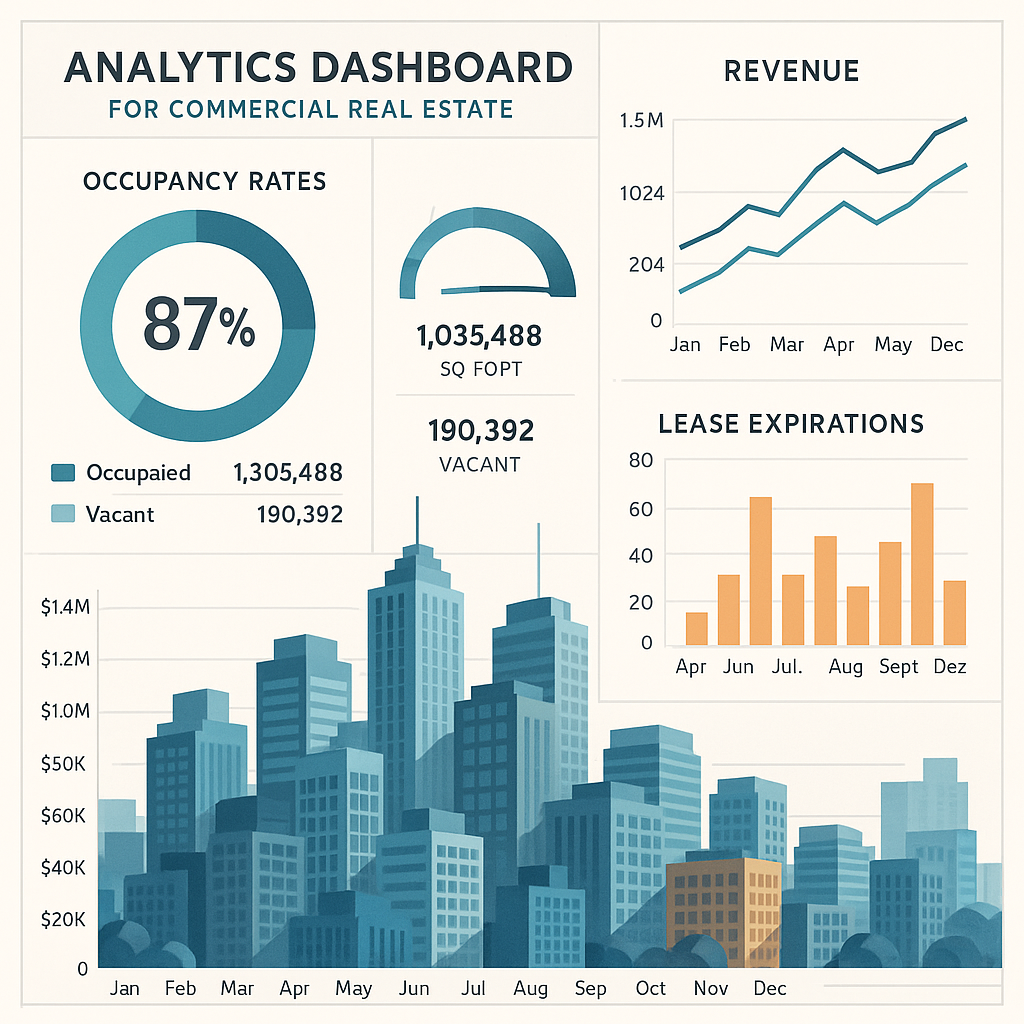
- Portfolio analytics and business intelligence — occupancy dashboards, effective rent calculations, NOI tracking, lease expirations, scenario modeling and predictive forecasts for budgeting and capital planning.
- Document, compliance and risk management — centralized lease files, insurance certificate tracking, audit trails and configurable retention policies to support regulatory reviews.
Assess whether the vendor offers prebuilt templates for common property types, like office, retail, industrial, and mixed-use. Check if configurable workflows can match your operating procedures without heavy customization.
Deployment models and what to consider
Your IT strategy and regulatory obligations will influence the right deployment path.
Cloud SaaS advantages
SaaS offerings prioritize rapid deployment, automatic security patches and predictable subscription costs. They are often the best fit for organizations that want ongoing product innovation, built-in scalability and minimal infrastructure maintenance. SaaS environments also simplify multi-site access, mobile updates and vendor-managed backups, which reduce internal IT burden.
On-premises considerations
On‑premises installations remain relevant for organizations with strict data residency mandates, complex legacy integrations or internal policies that require hardware control. Expect larger initial capital expenses for servers, network security, and dedicated operations staff. Upgrades are typically less frequent and require coordinated change management.
Hybrid models are effective when sensitive financial data must remain on-site. Non-sensitive operational modules can run in the cloud. Validate the vendor’s architecture and support for secure hybrid connectivity before committing.
Security, compliance and data governance
Security practices should be a procurement gate. Review vendor evidence for:
- Encryption in transit (TLS 1.2+) and at rest
- Role-based access controls and least-privilege enforcement
- Multi-factor authentication and single sign-on support
- Regular third-party penetration testing and vulnerability remediation
- Compliance certifications such as SOC 2 Type II, ISO 27001 and region-specific privacy attestations
- Documented incident response and breach notification timelines
Include contractual obligations for retention policies, backup frequency, recovery time objectives (RTO) and recovery point objectives (RPO). Ensure the vendor provides a disaster recovery and business continuity plan and validates those plans with regular tabletop exercises or failover tests.
Integration landscape and APIs
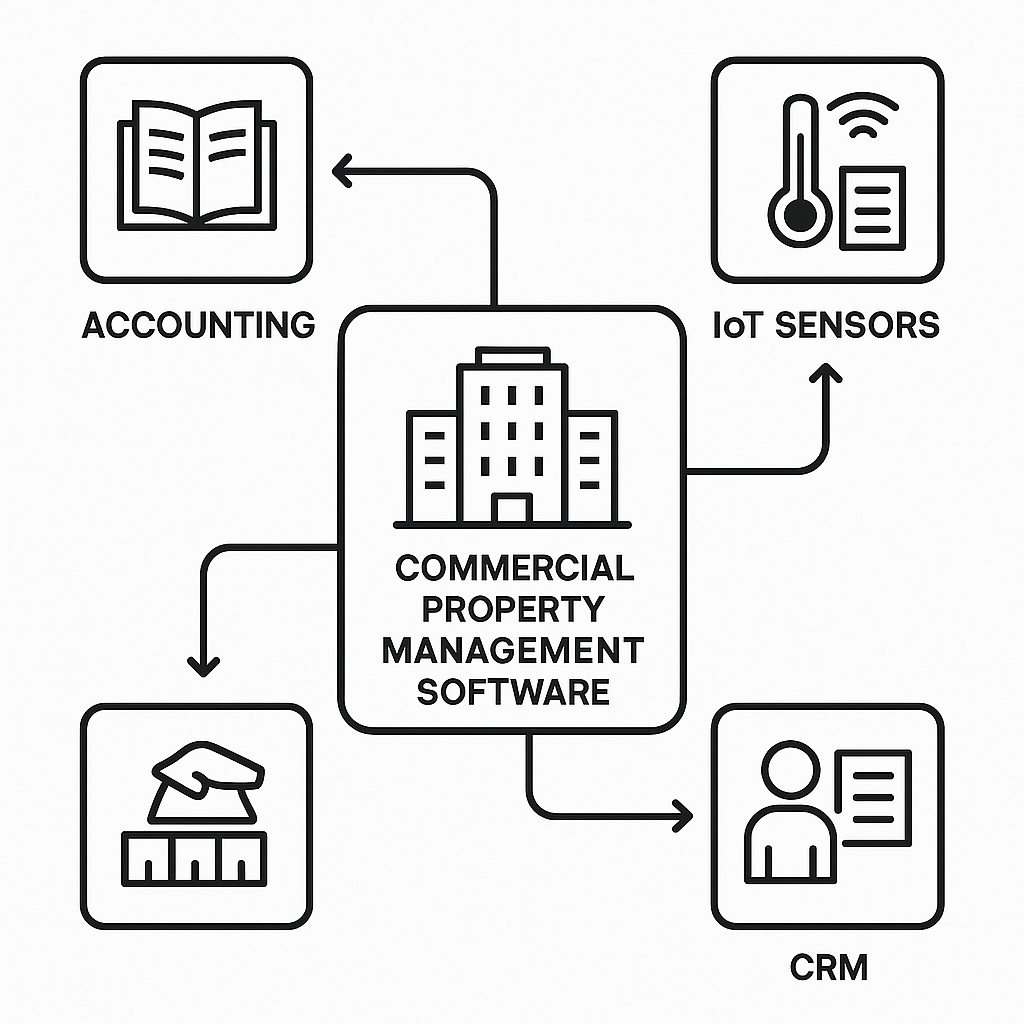
Property operations rarely run in isolation. Confirm that the solution supports robust integrations with your existing ecosystem:
- Core accounting platforms and enterprise ERPs for consolidated financials
- CRM and leasing lifecycle tools for prospect to tenant workflows
- IoT and building management systems for energy, HVAC and access control telemetry
- Payment gateways and banking partners for lockbox, ACH and card processing
- Vendor management and procurement systems for onboarding, invoicing and contract tracking
Look for RESTful APIs, event-driven webhooks, EDI and prebuilt connectors for major ERPs. Verify the vendor’s developer documentation, sandbox environments and SLAs for API uptime. Insist on sample integration scripts or reference implementations that mirror your intended flows to reduce custom development risk.
Usability and mobile capabilities
Operational adoption is a primary success factor. A modern user experience minimizes data re-entry, simplifies common tasks and speeds decision-making. Evaluate:
- Mobile apps for offline work-order creation, photo capture, time tracking and signature collection
- Role-specific dashboards for property managers, finance teams, leasing brokers and field technicians
- Configurable forms and templates to standardize data capture across properties
- Accessibility, localization and multi-language support if you operate in multiple regions
Request usability feedback from current customers in similar roles, and run internal usability sessions during vendor demos to gauge intuitive workflows and learning curve for frontline users.
Cost structure and total cost of ownership
Subscription price is only one part of the equation. Clarify the total cost profile which typically includes:
- Implementation and professional services (process mapping, configuration)
- Data migration and cleansing for leases, vendor records and historical balances
- Custom integrations and any middleware licensing
- Training, change management and internal communications
- Ongoing support tiers, user licenses and premium modules
- Periodic upgrade or add-on costs and any transaction or payment processing fees
Request a three- to five-year TCO worksheet from vendors that models realistic growth scenarios, user seat expansion and integration maintenance.
For practical ROI examples related to facilities and service-driven models, review complementary resources such as Hvac Proposal Software Selection And Roi, which explains cost-saving mechanisms where vendor tools align with maintenance and proposal workflows.
Vendor selection checklist
Use a standard checklist to compare candidates objectively. Key evaluation criteria include:
- Functional fit for your property types and leasing models
- Security posture and availability of compliance reports
- Integration capabilities and availability of certified connectors
- Supported deployment models and alignment with IT governance
- Transparent pricing and realistic TCO estimates
- Customer references, case studies and industry-specific track record
- Product roadmap clarity, release cadence and upgrade policy
- Support response times, professional services capacity and training offerings
Score each vendor on these criteria and weight them by importance to produce a defensible recommendation for stakeholders and procurement committees.
Implementation best practices
Disciplined program management reduces risk and establishes early wins. Structure the project into clear phases with accountable owners.
Phase 1 Planning and discovery
- Document current-state processes, system interfaces and manual workarounds.
- Define success metrics: reduced days-to-collect, maintenance SLA attainment, faster month-end close, or improved tenant NPS.
- Establish governance roles: executive sponsor, product owner, technical lead, data steward and vendor engagement manager.
- Create a detailed RACI matrix for key deliverables.
Phase 2 Configuration and integrations
- Favor out-of-the-box configurations to limit long-term maintenance burden.
- Prioritize integrations that eliminate manual spreadsheets and reconcile points of failure first.
- Build a test plan including functional, integration and security tests using representative sample data.
Phase 3 Data migration and validation
- Develop a migration playbook for leases, tenant accounts, vendor records and opening balances.
- Run reconciliation cycles: ensure trial balances, AR aging, and CAM statements match legacy outputs, or explain any differences with documented transformation rules.
- Keep legacy systems accessible as an audit reference during parallel operations.
Phase 4 Training and go-live
- Deliver role-based training and create quick-reference job aids for day-to-day tasks.
- Deploy regional super users who can triage issues and accelerate adoption.
- Consider a phased roll-out by asset class, geography or business unit to limit disruption in complex portfolios.
- Plan hypercare support for 30–90 days post go-live with defined escalation paths.
Measuring ROI and performance
Define baseline metrics and track improvements against measurable KPIs. Common indicators include:
- Days sales outstanding (DSO) for rent and common charges
- Average lifecycle time for maintenance requests and SLA compliance
- Reduction in manual accounting adjustments and reconciliation exceptions
- Improved audit accuracy and fewer compliance issues
- Tenant satisfaction and retention rates tied to portal usage and service quality
- Time-to-close for month-end and frequency of finance escalations
Request vendor case studies with quantified results for comparable portfolios. Supplement vendor claims with references where possible, and construct a conservative savings model to support procurement approvals. See additional service-focused ROI frameworks in our resource section like the Psa Software Buying Guide, which helps translate operational efficiencies into financial impact.
Negotiation tips and contract terms to watch
Contracts should protect your business continuity and limit vendor risk. Key clauses to negotiate:
- Data ownership and portability — explicit ownership of tenant and financial data, machine-readable export formats and vendor assistance during offboarding.
- Service level agreements (SLAs) — uptime commitments, incident response windows, scheduled maintenance windows and remedies for breaches.
- Pricing and change control — caps on annual price increases, defined change request processes and advance notice for new fees.
- Customizations and IP — rights to configurations, access to configuration metadata for portability and fees for extracting bespoke features.
- Termination and transition assistance — guaranteed transition support, escrow arrangements for critical code or integrations and data extraction services.
- Indemnities and liability limits — ensure appropriate caps and carve-outs for gross negligence or data breaches.
Ask for a sample statement of work (SOW) and a clear delivery schedule. Break down professional services estimates by deliverable and include acceptance criteria tied to functional test cases.
Operational governance and continuous improvement
Long-term value depends on governance that monitors adoption and drives continuous improvement. Recommended practices:
- Establish a product steering committee with stakeholders from operations, finance, leasing, IT and procurement.
- Review adoption metrics, open support tickets and outstanding integration work on a quarterly basis.
- Use vendor roadmaps to align upcoming releases to your operational priorities and plan staged rollouts.
- Implement a continuous feedback loop: collect frontline suggestions, triage enhancements and track realization of benefits.
Regularly audit configuration drift and ensure harmonization across regions to prevent divergent processes that increase overhead and reporting complexity.
Selecting the right vendor profile
Vendors vary by industry focus, platform maturity and go-to-market strategy. Match vendor profile to your strategic priorities.
Specialist commercial platforms
Specialists focus on the commercial real estate sector and typically ship deep lease accounting, CAM reconciliation and tenant billing out of the box. They can accelerate time-to-value for portfolios with standard commercial lease structures.
Enterprise ERP and real estate suites
Large ERP providers offer comprehensive financial and operational suites suitable for corporate portfolios that prefer a single-vendor landscape. These solutions can reduce integration overhead but may require heavier customization to match property workflows.
Mid-market cloud providers
Mid-market cloud-native vendors balance modern usability with competitive pricing and frequent feature releases. They often excel at mobile workflows and rapid deployment for geographically distributed operations.
When comparing, weigh product depth against implementation risk and vendor support capacity. Smaller vendors can deliver personalized service, while larger vendors provide broader enterprise tooling and longer-term roadmap stability.
Case study illustrations and practical examples
Real-world scenarios clarify trade-offs and expected outcomes:
Regional owner with mixed-use assets
A regional owner operating retail and office buildings prioritized tenant portals, CAM automation and mobile maintenance. By implementing a targeted solution and configuring standard CAM templates, they reduced manual reconciliation time by 70% and improved maintenance response times by 40% within 12 months.
Institutional operator with multiple funds
An institutional operator with multi-entity accounting needs integrated the selected system with a corporate ERP and automated month-end reconciliations. Automation reduced close time by several days and improved consolidated reporting accuracy for investor reporting cycles.
Frequently asked questions buyers ask
How long does a typical implementation take?
Timelines vary with scope. Small to mid-market implementations often complete in 8–16 weeks. Enterprise rollouts with complex integrations, multi-entity reporting and extensive data migration can take six months or longer. Factor in buffer time for data validation and user training.
Can I migrate legacy lease data without business disruption?
Yes. A phased migration approach with parallel runs for critical financial processes validates balances and reduces risk. Keep legacy access for historical reference and run reconciliation cycles until you prove data parity.
What level of customization is advisable?
Favor configuration over custom code to reduce upgrade and maintenance costs. If bespoke workflows are essential, negotiate migration clauses or exportable configuration artifacts to avoid vendor lock-in.
Next steps for buyers with purchase intent
To move the procurement forward, prepare an internal requirements document that includes portfolio attributes, desired modules, integration requirements, governance structure and success metrics. Typical attachments for an RFP or vendor shortlist include:
- Asset inventory and property types
- Sample lease templates and common clauses
- Chart of accounts and reporting requirements
- Target integrations and API requirements
- Security and compliance checklist
- Proposed implementation timeline and budget constraints
During vendor demos, use scripted scenarios that reflect your highest-volume transactions and edge cases (e.g., percentage rent calculation, CAM true-up flows, tenant chargebacks). Ask vendors to perform live demonstrations using anonymized data to evaluate performance, usability and integration behavior.
Explore additional resources on our site including company information via About Us, policy details in our Privacy Policy, and insights on product selection in our Blog.
If you have internal stakeholders to coordinate, establish a procurement timeline and schedule vendor demos focused on your top scenarios. Use our Contact page to request tailored advice or to arrange a vendor shortlist review. For account-level actions, visit the Edit Profile page or return to the Home page for quick navigation.
Vendor evaluation scorecard template
Use a weighted scorecard to make an objective decision. Example weighting:
- Functionality and fit: 30%
- Security and compliance: 15%
- Integrations and APIs: 15%
- Implementation risk and timeline: 10%
- Total cost of ownership: 15%
- Support, references and vendor viability: 15%
Assign numeric scores for each category and calculate a weighted total. Include qualitative notes and reference client commitments such as guaranteed delivery dates and support response times to provide context for the numerical result.
Sample RFP checklist (short)
Include these elements in any request for proposal to accelerate vendor comparability:
- Executive summary and objectives
- Detailed functional requirements by module
- Security, compliance and data residency requirements
- Integration points and API expectations
- Implementation timeline with milestones and acceptance criteria
- Training plan and documentation deliverables
- Pricing model, license structure and TCO assumptions
- References and case studies from comparable clients
Making an informed selection for commercial property operations is a strategic investment. Through standardized evaluation, careful planning, and disciplined execution you can realize significant operational efficiencies, improve tenant satisfaction and protect asset value. Take a methodical approach to vendor demos, prioritize measurable outcomes, and ensure contractual protections are in place to secure long-term success.