


hvac proposal software Selection and ROI
This guide is written for contractors, estimating managers, and business owners who are actively researching and preparing to purchase hvac proposal software. It explains core features, vendor evaluation criteria, realistic return on investment (ROI) expectations, implementation steps, and practical adoption practices. The tone is corporate and reassuring, designed to help decision makers reduce procurement risk, accelerate measurable outcomes, and choose a solution that aligns with operational goals and compliance requirements.
Why HVAC businesses need proposal software
Market pressures—tight margins, rising material costs, and elevated customer expectations—make it essential that estimating and proposals are fast, accurate, and persuasive. A centralized proposal platform reduces manual entry, enforces pricing discipline, and produces professional documents that improve conversion. It also provides a single source of truth for parts, labor, and contract language. Core benefits include:
- Faster proposal generation with prebuilt templates and validated equipment libraries
- Fewer quoting errors through standardized parts, labor factors, and markup rules
- Consistent, branded documents that enhance credibility and speed buyer decisions
- Centralized records for reporting, audits, and continuous performance improvement
- Clearer handoff to operations, reducing rework and post-sale disputes
Business impact
When deployed with governance and training, a robust estimating platform can shorten estimate turnaround by as much as 70%, improve close rates through option-driven presentation, and sharply reduce scope-related rework. For organizations scaling replacement, retrofit, and maintenance work, the right tool converts inconsistent practices into repeatable processes that free technicians and sales staff to focus on revenue-driving activities and service quality.
Core features to prioritize
Not all products deliver equal value. Prioritize functionality that improves speed, accuracy, and the customer experience while supporting regulatory and financial controls.
Estimating and parts libraries
A robust parts and equipment library with manufacturer specifications, SKU-level pricing, and mapped labor factors is foundational. Evaluate libraries for breadth and the ability to add company-specific items. Key capabilities to request during demos:
- Bulk import/export and batch cost updates
- Versioning for price changes and historical lookups
- Region-specific cost profiles and tax treatments
- Configurable markups, discounts, and multi-tier pricing for trade accounts
Customizable proposal templates
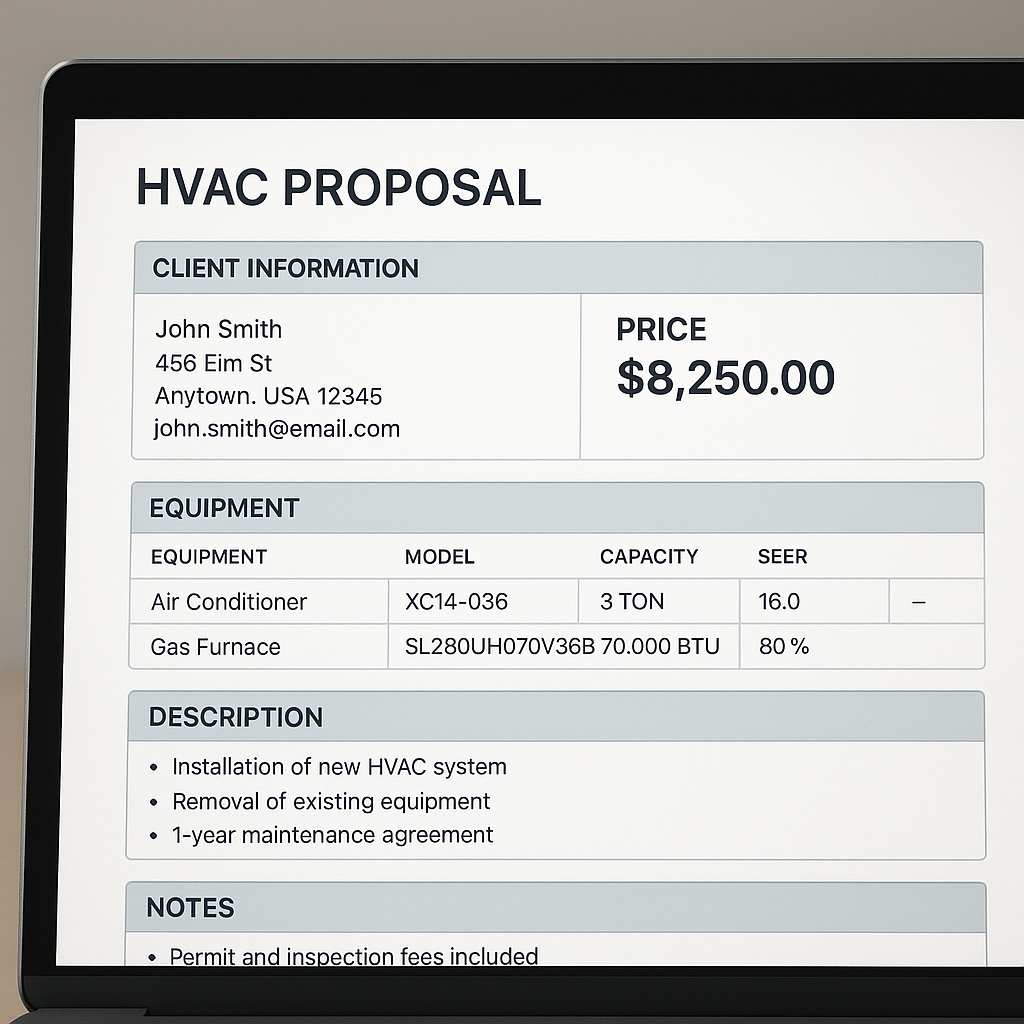
Templates should support images, scope narratives, itemized pricing, bundled options, financing calculators, and service agreements. Look for conditional content blocks that render based on selections, which reduces manual edits and keeps messaging consistent. Ensure your chosen solution can produce client-facing PDFs and mobile-optimized proposals.
Integration with CRM and accounting
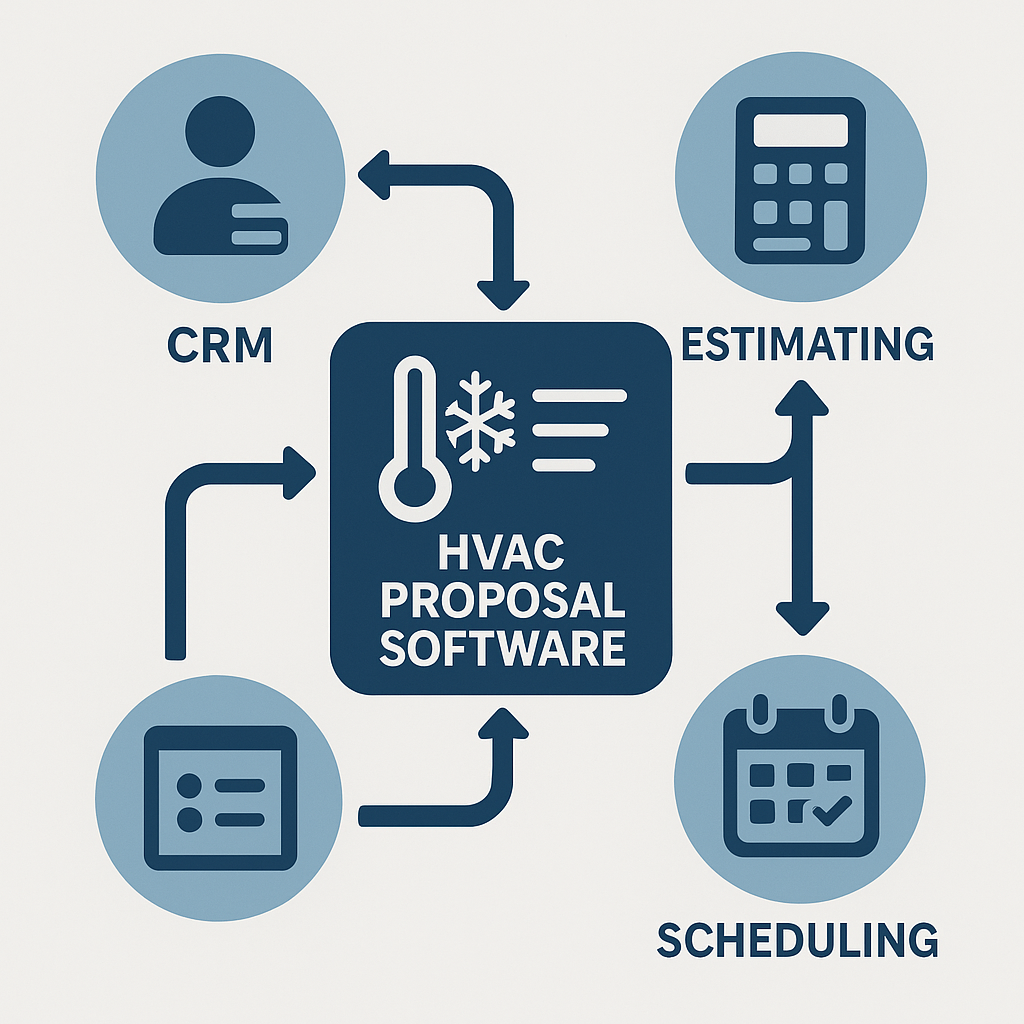
Seamless integration with CRM, scheduling, and back-office systems reduces duplicate entries and preserves accounting integrity. Confirm prebuilt connectors for your accounting package, your field service management platform, and CRM. If your operations require bespoke links, verify the availability of an open API and vendor support for custom integrations.
Digital signatures and e-sign workflows
E-signature capabilities embedded in proposals accelerate acceptance and create auditable trails for compliance and warranty triggers. Assess supported signature methods, storage duration, and whether signed documents can trigger downstream workflows like dispatch or invoicing.
Mobile access for field teams
Field-ready apps enable on-site quoting, photo capture, and signature collection. Prioritize software with intuitive mobile interfaces, offline editing for low-connectivity environments, and a small footprint for faster installs and updates. Evaluate UX with your typical field tasks to ensure minimal friction for technicians.
Reporting and analytics
Actionable reporting highlights win rates, average ticket size, lead-to-close times, and margin trends. Look for customizable dashboards, scheduled exports, and the ability to drill from corporate metrics down to individual estimator performance. Reporting should support both strategic review and operational troubleshooting.
Vendor selection criteria
Selecting a vendor is as important as choosing the product. Use objective criteria to compare offerings, confirm support viability, and ensure long-term fit with your business model.
Industry experience and case studies
Vendors with proven experience in mechanical contracting or related trades often provide templated workflows and device-specific libraries that shorten implementation time. Ask for case studies with quantifiable before-and-after metrics from customers similar in size and service mix to your business.
Product roadmap and support
Assess the vendor’s release cadence, transparency around roadmap items, and the structure of their customer success organization. A supplier that publishes release notes, runs beta programs, and offers tiered support reduces operational risk and ensures the product can evolve with your needs.
Security, compliance, and data governance
Validate encryption practices, role-based access controls, logging, and data residency commitments. For payment processing and handling of personal data, confirm PCI compliance and ask for SOC reports or equivalent attestations. Clarify retention policies, backup cadence, and incident response procedures.
Pricing and total cost of ownership
Request a detailed cost model that includes subscription fees, onboarding, integrations, training, and per-transaction or storage charges. Evaluate these costs against projected efficiency gains, margin improvements, and revenue uplift to calculate net benefit, payback period, and multi-year ROI.
Calculating ROI for HVAC proposal software
Model investment justification using conservative assumptions. Primary value levers are reduced estimate creation time, improved close rates, fewer scope disputes, and more efficient field handoff. Build sensitivity analyses around close-rate improvement, average ticket size, and labor-hour savings.
Example ROI model
Consider a mid-sized contracting firm with eight estimators producing 200 proposals per year at a $5,000 average ticket and a baseline close rate of 25%:
- Annual proposals: 1,600
- Closed jobs today: 400
- Revenue from closed jobs: $2,000,000
Apply conservative gains: a 10% relative increase in close rate and a 50% reduction in estimating time:
- New close rate: 27.5% (from 25%)
- New closed jobs: 440 (+40)
- Incremental revenue: $200,000
- Labor savings: 1,600 hours (assuming 1 hour saved per proposal)
Monetize labor savings using your loaded labor rate and apply incremental margin to additional revenue. Factor in subscription, onboarding, and integration costs to calculate net benefit. In many cases, payback occurs in 6–18 months, but vary assumptions for a conservative and an optimistic scenario. Also include qualitative benefits like improved brand perception and reduced dispute handling time.
Implementation roadmap
A phased rollout minimizes disruption and accelerates value capture. A practical approach includes data cleanup, controlled pilots, and staged rollouts with continuous measurement.
Phase 1 — Setup and data migration
- Inventory pricing lists, manufacturer specs, labor rates, and contract clauses
- Clean and normalize data to avoid downstream quoting errors
- Define integrations, master data sources, user roles, and permission matrices
- Agree acceptance criteria and go/no-go checkpoints with the vendor
Phase 2 — Pilot deployment
- Choose a representative pilot group: estimators, sales reps, and field techs
- Run live jobs and iterate templates and libraries based on feedback
- Measure time-to-proposal, acceptance rates, error frequency, and user satisfaction
- Capture support tickets and escalate product gaps early
Phase 3 — Training and full rollout
- Deliver role-based training with hands-on scenarios and checklists
- Provide quick reference guides, FAQs, and enforce standardized templates
- Monitor KPIs and refine processes in short feedback cycles, using two-week sprints
- Plan ongoing governance: library stewardship, price updates, and periodic audits
Change management and user adoption
Successful deployments depend on people and process change as much as technology. Executive sponsorship, local champions, and clear performance metrics underpin sustainable adoption.
Champion network
Identify internal champions across estimating, operations, and service who can advocate for the new process, coach peers, and collect improvement ideas. Equip champions with performance reports and authority to enforce standardized templates.
Incentives and KPIs
Align incentives with desired behaviors: response time, proposal completion, signed proposals per period, and documented follow-ups. Use dashboards to make progress visible, celebrate quick wins, and reinforce momentum with targeted coaching where adoption lags.
Common integrations and technical considerations
Integrations reduce manual work and increase data accuracy. Typical touchpoints include CRM, accounting, field scheduling, inventory, and vendor catalogs.
APIs and prebuilt connectors
Choose vendors that provide documented REST APIs and prebuilt connectors to mainstream platforms. Prebuilt connectors shorten timelines and reduce custom development risk. When custom work is required, require a specification and change-control process to manage scope and cost.
Data synchronization and authority
Establish a clear master-data strategy: designate authoritative systems for customer and pricing data to avoid sync conflicts. Define conflict resolution rules, scheduled reconciliation processes, and audit logging to track changes and who made them.
Mobile and offline capabilities
Field teams often face limited connectivity. Verify the mobile app supports offline drafting, attachments, and a resilient sync process to prevent data loss. Test sync scenarios, conflict resolution, and performance with realistic job-site media like high-resolution photos and long specification documents.
Security, compliance, and data governance
Protecting customer and financial information is mandatory. Evaluate vendor security policies, encryption standards, access controls, and incident response procedures before signing any contract.
- Require encryption at rest and in transit and multi-factor authentication for administrative accounts
- Enforce role-based access controls and maintain immutable audit logs for regulatory review
- Confirm compliance with industry standards, contractual obligations, and data residency requirements
Pricing models and what to expect
Subscription models vary and can significantly affect total cost of ownership. Typical billing includes per-user subscriptions, setup fees, integration charges, and optional modules for advanced functionality. Ask for a three-year TCO to understand long-term impact.
Typical billing elements
- Base subscription per user or company-level licensing
- Initial onboarding and data migration fees
- Integration and custom development costs
- Storage/transaction fees for large media or high proposal volumes
- Premium support tiers and professional services for complex rollouts
Best practices for proposal templates and pricing
Well-designed templates drive clarity and faster customer decisions. Keep content scannable, present options in a comparative layout, and surface the recommended choice to guide buyers.
Keep proposals clear and scannable
Use concise sections, bullets, and a price-summary at the top. Call out next steps, conditions, and accepted payment methods to reduce hesitation and speed approvals.
Offer financing and service plans clearly
Display financing and maintenance offerings side-by-side, with a recommended choice and simple payment examples. Transparent terms reduce objections and improve conversion.
Standardize scope language
Consistent descriptions for repeated work reduce disputes and speed approvals. Maintain a central repository for approved scope language, attachments, and warranty statements to ensure legal and operational consistency.
Procurement checklist and negotiation tips
Treat vendor selection like a formal procurement exercise. Use a scoring matrix, clarify SLAs, and negotiate exit terms to limit lock-in and preserve flexibility.
Demo evaluation checklist
- Can the vendor replicate a representative live proposal in under 10 minutes?
- Does the product support conditional sections, bundles, and financing calculators?
- Which integrations are included in the quoted price versus add-ons?
- How are data exports handled, and do they include attachments and audit history?
- What are standard support response times, escalation paths, and SLAs?
Contract and SLA items to negotiate
Negotiate clear terms for uptime, maintenance windows, data export formats, onboarding deliverables, and defined acceptance criteria for go-live. Include a migration clause, a reasonable termination notice, and a practical dispute resolution process to protect against vendor changes or service degradation.
Measuring success after go-live
Define success metrics before launch and measure them regularly. Use both adoption and business outcome KPIs to assess value capture and to guide continuous improvement.
Recommended KPIs
- Proposal cycle time (lead-to-proposal and proposal-to-sign)
- Proposal completion rate and signed proposals per user
- Average ticket value and close rate
- Estimator productivity (proposals per day/hour)
- Reduction in post-sale change orders and dispute resolution time
Quarterly review process
Hold quarterly reviews with business stakeholders and the vendor to review KPIs, surface product requests, and plan optimizations. Use these sessions to adjust templates, refine pricing strategies, and prioritize roadmap items that deliver measurable returns.
Common pitfalls and how to avoid them
Awareness of common failure modes reduces the risk of wasted investment and prolonged rollouts.
- Poor data hygiene — start with a focused data-cleaning sprint before migration
- Insufficient training — invest in role-specific, scenario-based sessions and ongoing refreshers
- Lack of executive sponsorship — secure leadership alignment and clear accountability
- Underestimating integration complexity — validate connectors and scope before signing
- Over-customization — prefer standard processes to retain upgradeability and lower support costs
Real-world use cases
Examples of common scenarios demonstrate where the platform delivers tangible benefits and operational improvements.
Replacement and retrofit sales
Field technicians present multiple replacement options with efficiency comparisons, warranty terms, and financing to help homeowners decide quickly. Visuals, side-by-side comparisons, and clear next steps reduce decision friction and lower on-site sales cycles.
Commercial bidding and subcontractor coordination
For commercial projects, integrated equipment schedules, version control, and shared libraries reduce misalignment between estimating and execution teams. This improves bid accuracy, reduces costly change orders, and streamlines subcontractor coordination.
Recurring maintenance and service agreements
Automated service agreement templates streamline renewals, standardize offerings, and protect recurring revenue streams. Scheduled renewals and transparent tiered pricing make it easier for account managers to retain clients and upsell preventive services.
FAQs
How long does implementation typically take?
Smaller teams can go live in 4–8 weeks for a basic configuration; larger operations with complex integrations often require 3–6 months. Timelines depend on data readiness, integration scope, and internal change management capacity.
Will a proposal system replace our CRM?
No. Proposal platforms complement CRMs by handling specialized estimating and document generation. Integration allows each system to focus on core strengths while preserving a single customer record and preventing inconsistent data entry.
Can I import existing pricing and templates?
Most vendors accept CSV imports and template transfers, but formats and attachment handling vary. Confirm supported formats and request migration assistance and test imports as part of your onboarding package to avoid surprises.
What training resources should I expect?
Expect role-based training, on-demand video libraries, and live support during rollout. Vendors that offer train-the-trainer programs, certified implementation partners, and documented use-cases generally achieve higher adoption rates and faster ROI.
Final considerations before signing
Before committing, validate references from similar-size contractors, request a timed demo using a sample proposal, and demand clear acceptance criteria for go-live. Confirm ongoing fees, data ownership terms, export capabilities, and the vendor’s support SLAs. Ensure your procurement scorecard includes both functional fit and long-term operational considerations.
Choosing hvac proposal software is a strategic investment in operational efficiency, risk reduction, and top-line growth. A methodical evaluation process, careful data preparation, and disciplined adoption plan are keys to realizing benefits quickly while minimizing implementation risk. Use the procurement checklist and demo questions above to structure your buying process and protect your company’s interests.
For more information about our editorial standards and data usage visit the Privacy Policy. To learn about the team behind our guides see About Us or return to the Home page. If you have specific questions about software selection contact our team via the Contact page. Browse related analysis and updates on our Blog. For terms governing site use see our Terms and Conditions.